One Singular Sensation
The time that I drank only one wine...

Over the past several decades, I’ve had both good and bad ideas about drinking wine. One of my recent ideas may belong in both camps.
I decided to drink just one wine- repeatedly- over a period of several weeks. I figured it would be like intently studying a single work of art or reading the same book several times to more fully grasp its meaning and nuance. At least that’s what I told myself after I impulsively purchased multiple bottles of the same wine.
The wine in question wasn’t fancy or cool or particularly sought-after – it wasn’t even a wine I’d tasted before. Made from a grape few oenophiles know and produced in a place that only wine drinkers and skiers can find on a map, it was affordable too.
The wine I chose for my mission was the 2024 Franz Gojer Alte Reben Vernatsch ($20) a red wine from the Alto Adige region Italy. Although the Vernatsch grape is virtually unknown outside of Alto Adige aka South Tyrol and Germany, Vernatsch is an important grape. It’s also a grape that goes by three names.
Vernatsch is the name that German-speaking winemakers in South Tyrol employ while in Germany it’s known as Trollinger and Italians call it Schiava. Such a cultural mashup might be credited to the fact that Alto Adige belonged to Austria until it was annexed to Italy at the end of World War I. The region (still) looks and sounds more Austrian than Italian. In fact, when I first visited Alto Adige nearly two decades ago and the vintners spoke of their “export markets” they named Italy.
The Gojer family is German-speaking and therefore call their wines Vernatsch. The Gojers are singularly devoted to the grape, producing three different Vernatsch bottlings – an abundance owed to the fact that their winery is located in a Vernatsch sweet spot: the St. Magdalener region. “It is the most renowned area for growing Vernatsch, and it is here that the region’s highest quality Vernatsch wines come from,” Mr. Gojer wrote in an email. “Vernatsch grows here on terraced, steep slopes and hillsides and is mainly cultivated using the traditional pergola method,” he added.
Five generations of Gojers have been producing wine although their winery whose name is Glögglhof dates all the way back to the 14th century. Florian Gojer noted, “Here in South Tyrol there is a tradition that the farm of the winegrowing family has a name. Glöggl means “little bell” and hof means “farm.”
What a likeable name-Little Bell Farm - just as likeable as the wine itself- a juicy, wonderfully aromatic red (think: cherries and spice and a hint of florals) with a crisp acidity and fine tannins and above all, a terrific versatility with all sorts of food. It matched as effortlessly with meat as it did fish and pasta. It was also a wine that pleased a wide range of palates: There wasn’t a friend with whom I shared my Vernatsch who wasn’t also a fan although their enthusiasm may not have quite equaled mine.
While I liked the Gojer wine a great deal, I liked the family’s singular devotion to an obscure grape even more. It will never make them famous or rich but at Little Bell Farm- they’re clearly in it for the love.
…………..
Have you ever focused on one wine completely, eschewing all others, at least for a while? I’d love to hear your story- and if you’re a Vernatsch fan I’d love to hear about that as well.
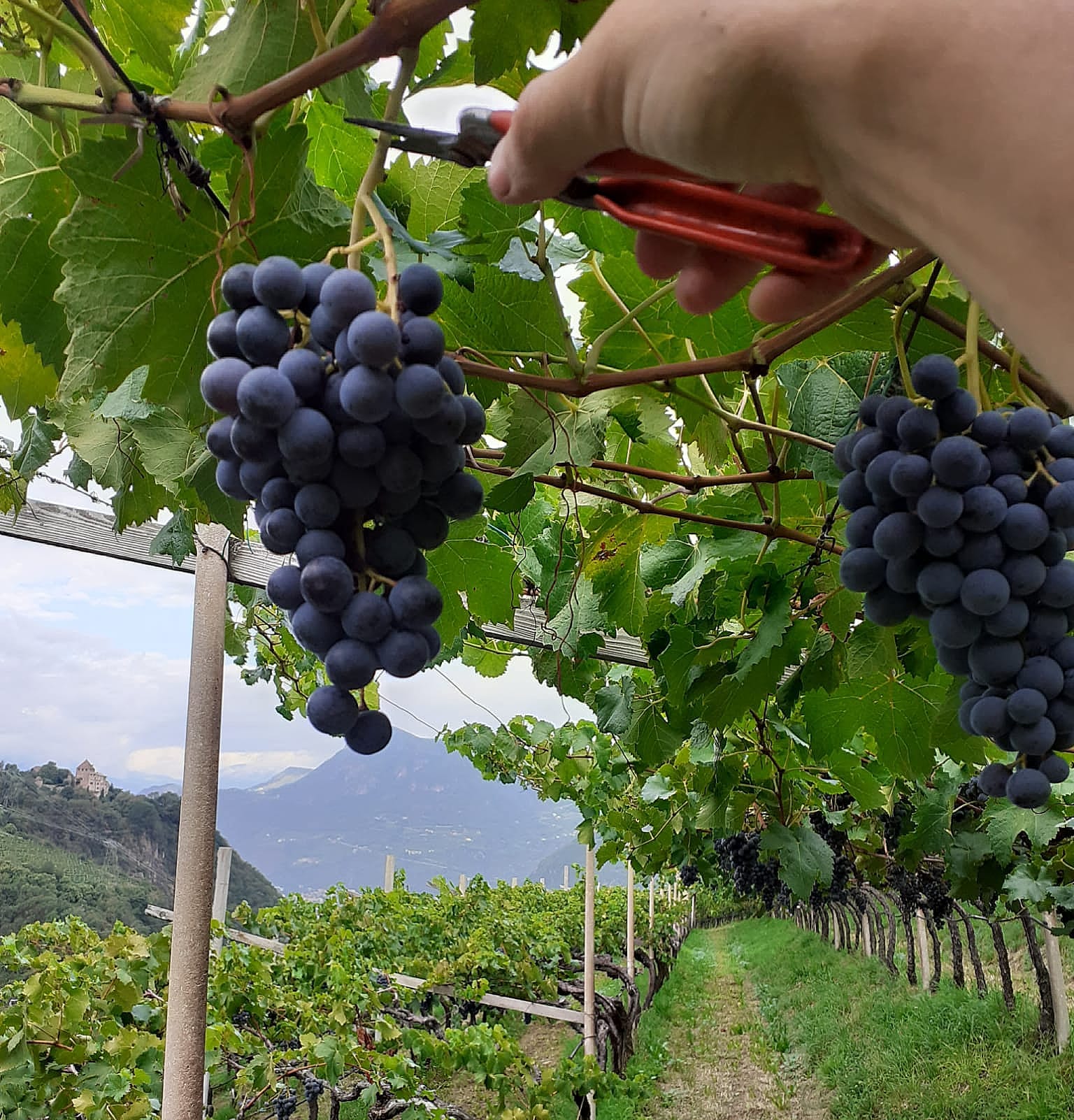
(Image of Vernatsch grapes courtesy of Florian Gojer)
I have one further recommendation of a well-priced Alto Adige wine: the 2024 J. Hofstätter Weissburgunder ($16). Produced at an estate famous for its Pinot Nero/Pinot Noir, one that I visited on my long-ago Alto Adige trip, this Weissburgunder aka Pinot Blanc is a lush, round, slightly tropical white whose lushness is nicely offset by a lively acidity. It’s a good example of the terrific PQR of so many Alto Adige wines - both white and red.
What a fun experiment to drink just one wine and especially picking this one! I fell for schiava after first tasting one from Elena Walch, which remains a favorite. I’ve since enjoyed Girlan (their pinot nero is also stunning) and Abbazia di Novacella. I have been lucky to visit Alto Adige twice and continue to promote the area’s wonderful wines (the crisp acid-driven whites are tops!) as well as the breathtakingly beautiful area itself.
How fun! The only Schiava I have ever had is one by Lageder (I loved it, especially in the summer). Fun to know this grape by its German name!